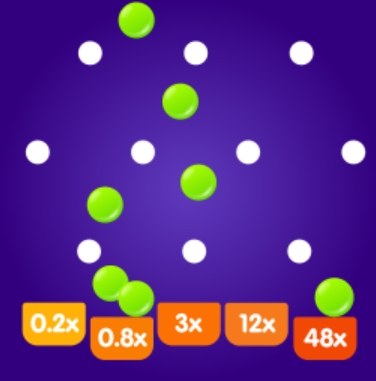
Plinko Frenzy is a slow-burn physics game disguised as a luck-based party title, where you drop balls through a static pegboard to land in multiplier buckets. It rewards patience, position memory, and small adjustments over frantic edge-chasing. This suits players who enjoy meditative optimization and incremental improvement rather than flashy chaos or fast reflexes.
First Drop Feels Heavier Than It Should
I launched Plinko Frenzy expecting something frantic — the name practically dares you to picture balls spraying everywhere while numbers tick up like a casino slot. Instead, the first sixty seconds are oddly quiet. You're looking at a clean pegboard, a single ball sitting at the top, and a row of multiplier buckets along the bottom. The music is a subdued loop, almost meditative. I dragged my finger left and right, watching the drop preview line shift, and let the first ball go without much thought. It clattered down through the pegs, bounced off three I didn't expect, and landed in a 2x bucket. Nothing exploded. No bonus round triggered. Just a calm "nice one" feeling and a prompt to drop again. That restraint is the whole trick here — Plinko Frenzy wants you to believe it's a chaos game, but it's really a patience test wearing a party hat.
The Loop Isn't About Speed, It's About Position Memory
Each round gives you a set number of balls, usually starting at ten or fifteen. You're not racing a clock. You can sit there for thirty seconds between drops if you want, and honestly, you should. The board layout stays static for the entire session, which means the peg arrangement you see on drop one is the same on drop fifteen. This is where the strategy layer creeps in. After a few balls, you start noticing patterns — a slight rightward drift from the top-center drop point, a nasty cluster of pegs about two-thirds down that tends to kick balls hard left. The game is quietly asking you to build a mental map of the board's physics. I found myself muttering "okay, that one went wide right, so next one I'll nudge a hair left of center." It's not random, or at least not purely random. The physics model has enough consistency that drop position matters more than you'd think.
What you're optimizing for is multiplier consistency, not jackpot chasing. The center buckets usually sit around 1.5x to 3x, while the edges dangle tempting 10x, 25x, even 50x returns. New players gravitate toward the edges immediately. I did too. But here's the thing: the peg geometry near the edges is brutal. Those high-multiplier buckets are flanked by zero-value or even negative zones, and the pegs seem engineered to deflect balls away from them unless your drop angle is perfect. Over fifteen minutes of play, I landed maybe two edge jackpots. The rest of my edge attempts either plunked into nothing or dribbled into a 0.5x pity bucket. Meanwhile, my center-dropped balls quietly stacked 2x after 2x after 2x. The math isn't flashy, but it's relentless.
What Actually Ends Runs Early
I burned through my first three sessions in under two minutes each because I made the same mistake repeatedly: treating each ball like an independent event. Psychologically, it's hard not to. You see the board reset, the ball count tick down, and your brain goes "new drop, new luck." But the board doesn't change. If you just watched a ball from the leftmost drop position veer hard into a zero bucket, dropping the next ball from that exact same spot is asking for a repeat. I did this four times in a row before I caught myself. The game punishes what I'd call "hope dropping" — placing the ball based on where you wish it would go rather than where the last three drops suggest it will go.
Another run-killer: overcorrecting. After a ball lands left, the instinct is to yank the drop point way right. But the pegboard doesn't mirror symmetrically. A slight nudge is usually enough. I lost count of how many balls I sent screaming into the right-side zero zone because I overcompensated for a left miss. The sweet spot for adjustments feels like about 15% of the board width, not 50%. It took me maybe ten minutes of focused play before my thumb learned that granularity.
The third mistake is ignoring ball count pressure. When you're down to your last three balls and you're below the score threshold to continue or unlock whatever the session goal is, panic sets in. That's when you start edge-chasing. I did it. Everyone will do it. But the game seems designed to make edge-chasing fail more often than not when you're desperate. The physics doesn't care about your score. Better to take two safe 2x drops and scrape through than to yolo a 25x attempt and walk away with zero.
Phone Versus Desktop — It Matters Here
I played on both. On desktop, using a mouse, the drop positioning feels precise. You get a nice long drag line, and releasing the click feels deliberate. I could consistently place balls within a few pixels of where I intended. On a phone, things get mushier. Your thumb obscures the drop preview, especially if you're holding the device one-handed. I found myself accidentally releasing early or late because my thumb would slide slightly during the drag. The game is absolutely playable on mobile — it's clearly designed for it — but you'll want to use two hands or at least brace your phone on a surface. One-handed play led to about 20% of my drops landing somewhere I didn't mean to, which over a session adds up to a lot of lost multiplier.
There's also a screen size consideration. On smaller phones, the pegboard compresses and the visual difference between drop positions becomes harder to distinguish. I played on a standard-sized screen and an older, smaller device, and on the smaller one I genuinely couldn't tell if I was nudging the ball 5% left or 15% left. If you're on a compact phone, you'll need to rely more on feel and pattern memory than visual feedback. Desktop gives you the clearest advantage, but phone play feels more intimate and oddly satisfying once you adapt.
Who Should Actually Play This
Plinko Frenzy works for people who enjoy slow-burn optimization disguised as a luck game. If you've ever spent too long in a Peggle level trying to bank a shot perfectly, or if idle games appeal to you because of the incremental improvement rather than the flash, this will click. There's a meditative quality to dropping fifteen balls one by one, tracking results, and gradually tightening your accuracy. It's not about reflexes. It's about attention span.
If you're looking for a high-stimulation experience, skip this. There are no power-ups, no screen shakes, no cascading bonus multipliers that fill the board with fireworks. The "frenzy" in the title is aspirational at best. The game doesn't suddenly accelerate or throw curveballs. It's the same board, same pegs, same buckets every round. That consistency is the point, but if you need variety or escalating chaos to stay engaged, you'll be bored by the third session.
Also worth noting: this isn't a progression game in the traditional sense. I didn't unlock new boards, new ball skins, or new abilities in the time I played. It seems to be a single-screen experience where the replay value comes from self-improvement rather than content unlocks. If you need a carrot on a stick, this might not hold you. If you're the type who finds satisfaction in seeing your average multiplier creep up over ten sessions, you'll get it.
A Ten-Minute Practice Plan That Actually Helps
I spent my last chunk of playtime treating it like a deliberate practice session rather than casual play, and the difference was noticeable. Here's a structured ten-minute approach that helped me stop bleeding balls to zero buckets.
Minutes 0–2: Board mapping. Don't worry about score. Drop five balls from dead center, one at a time, and just watch. Note where each one lands. Is there a consistent bias? My board had a slight left tendency, which meant center drops kept ending up in the 1.5x left-of-center bucket. Knowing that bias is half the battle.
Minutes 2–4: Edge exploration without commitment. Pick one edge — left or right, not both. Drop three balls from the outermost drop position and observe the deflection pattern. On my board, far-left drops hit a peg around row four that kicked them violently toward the center, missing the left-edge high multiplier entirely. That told me the 25x left bucket was only reachable from a slightly-off-center-left drop, not a hard-left drop. I wouldn't have learned that without testing.
Minutes 4–7: Calibration drops. Now start adjusting in small increments. If center drops land left, nudge right by a tiny amount. Drop, observe, adjust again. The goal here isn't to score big — it's to find the drop position that reliably hits the 2x or 3x center buckets. You're building muscle memory for "safe" drops. I found my reliable center drop was actually about 10% right of true center. Once I locked that in, I could hit 2x or better on maybe 60% of safe drops.
Minutes 7–9: One edge attempt with purpose. Choose the edge you mapped earlier. Using what you learned, try to place a ball where the deflection pattern might actually funnel it into the high multiplier. Don't spam this. Drop two, maybe three balls max. If one hits, great. If not, you've confirmed the difficulty. The point is practicing the precision of the drop, not getting lucky.
Minutes 9–10: Full session simulation. Play one complete round as if it counts. Use your safe drop for 70% of balls, sprinkle in one or two edge attempts only when you're ahead of pace. Notice how different it feels to play with a plan versus reacting ball-by-ball. I scored higher in this single planned session than in my previous five combined, simply because I stopped donating balls to zero buckets.
This practice routine resets your relationship with the game. You stop seeing each ball as a gamble and start seeing the board as a system you can partially predict. It won't make you hit 50x every time — the physics has enough jitter to keep things interesting — but it will dramatically reduce those infuriating zero streaks. And honestly, watching a ball follow roughly the path you expected is more satisfying than any random jackpot.
Plinko Frenzy isn't going to light up your screen or get your heart racing. But if you give it fifteen focused minutes and resist the urge to flick balls around like a slot machine, it reveals itself as a quiet little strategy exercise. The name's a misdirect. The game's a slow nod, not a frenzy. Whether that's a pleasant surprise or a disappointment depends entirely on what you came for.