Tower Defense Galaxy is a challenging browser-based tower defense game where lane layouts shift mid-wave and enemy abilities force constant tactical adjustments. It suits players who enjoy losing, rethinking their tower placement and target priority, then scraping through on the next attempt. Skip it if you prefer idle mazing or narrative campaigns, as this one demands active attention and spatial problem-solving.
I loaded up Tower Defense Galaxy on a Tuesday lunch break and got flattened inside of six minutes. Not "oh, that was close" flattened—more like the aliens waltzed through my map like I'd forgotten to place any towers at all. The first minute feels deceptively gentle. A couple of basic enemy ships drift in from the left, your starting credits feel generous, and you plonk down a laser turret thinking you've got this. Then wave three hits and three lanes light up at once, the enemy mix changes, and suddenly you're watching little health bars leak past your kill zone while you frantically click a speed-up button you shouldn't have touched.
That opening scramble is the game's way of telling you this isn't one of those tower defense titles where you find a dominant strategy on map two and coast for twenty levels. Tower Defense Galaxy is scrappier. It demands you read enemy types aloud to yourself, reposition towers mid-wave, and occasionally sell a turret you just built because the pathing shifted and now it's pointing at empty space.
How the loop actually works
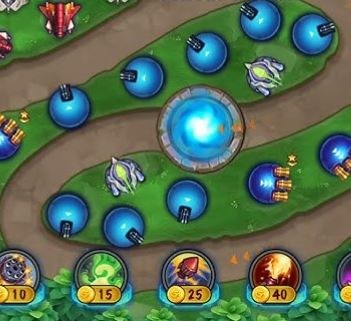
You pick a map—usually a node on a star chart, though the galaxy framing is mostly window dressing—and defend a fixed path or open grid against waves of alien ships. Enemies come in flavors: fast scouts that barely tickle your base but slip through slow-firing defenses, shielded cruisers that laugh at your starting lasers, and later, splitter types that break into smaller targets when destroyed. Your job is to build and upgrade towers at chokepoints, but the twist that caught me off guard is how often the lane layout changes between waves on certain maps. A rock might explode, opening a new entry point you didn't budget for. A previous kill zone might become irrelevant three waves later.
The currency loop is tight. You earn credits from kills and wave completions, and interest or bonuses feel minimal, so every spend matters. Towers upgrade along short trees—damage, range, fire rate, sometimes a special ability like a slow field or armor pierce. Selling a tower returns maybe sixty percent of its cost, so experimenting mid-wave is expensive but sometimes the only way to survive a bad placement call. Between maps you unlock new tower types, but it's not a skill-tree grindfest. Progression is more about learning which combos work against mixed compositions than it is about unlocking an overpowered turret that solves everything.
What you're really optimizing for is lane coverage overlap. One tower covering two lanes is worth two towers. A missile turret placed where its splash radius clips three approach vectors is worth five. The game rewards you for finding those sweet spots, and punishes you hard when you spread damage too thin across too many independent firing positions.
Common mistakes that end runs by wave four
The biggest one I see—and did myself for the first hour—is building towers right at the spawn point. It feels logical: hit them as soon as they appear. But the aliens accelerate slightly after taking damage, so early hits actually speed them through your subsequent towers. You want to build your first damage dealer about a third of the way into the path, where enemies bunch up naturally behind a turn. That turn is your real weapon. A missile tower on the inside corner of an L-bend will splash three or four ships at once, and the tight angle keeps them in range longer.
Second mistake: ignoring the "target priority" toggle that sits quietly in the corner of every tower's UI. By default, towers shoot the nearest enemy. Against a mixed wave where fast scouts screen for slow heavy cruisers, your turret will plink away at the scouts while the real threat waddles through unscathed. Switching a couple of towers to "strongest" or "last" completely flips a losing wave. I didn't touch this setting for my first ten runs because the interface doesn't shout about it, and I lost maps I should have won.
Third mistake: upgrading one tower to max while leaving the rest of your map at level one. A single giga-turret feels powerful, but it overkills small targets and gets swarmed during multi-lane waves. Spread upgrades across two or three towers first, then push one to its special ability breakpoint. That breakpoint—usually level three or four—is worth rushing because the ability spike often changes how that tower interacts with entire enemy types.
Fourth: not selling early enough. If an asteroid opens a back lane on wave five and your best tower is now guarding a dead route, sell it immediately and rebuild closer to the new merge point. I used to hold out, hoping the lane would close again. It never did. The credit penalty stings, but losing twenty base health to a leaked wave stings more, and base health doesn't regenerate between maps in the campaigns I played.
Sticky stages and how I got through them
Around the mid-game, you hit maps where the enemy composition feels designed to counter whatever you've been relying on. For me, that was the first ice-themed node—suddenly half the enemies had shields that absorbed the first three hits, and my rapid-fire lasers were essentially tickling them. I failed that map five times before I realized I needed to pair a single high-damage plasma cannon with a slowing field tower near the exit. The slow tower doesn't do much damage on its own, but it groups enemies so the plasma cannon's slow rate of fire doesn't miss. That combo—slow field plus high burst—became my template for shielded waves going forward.
Another sticky stage introduced enemies that healed each other. I didn't notice the heal beams at first; I just saw health bars going up and assumed I was misreading the numbers. Once I spotted the green tether, the solution was obvious: kill the healers first, even if they aren't the closest target. I had to manually set target priority on three towers to "weakest" to strip the healers out of the pack before they could do their work. That micro-level of attention is what separates clearing a map on the third attempt from bouncing off it entirely.
When you're stuck, replay an earlier map with a tower you never use. I ignored the tesla coil tower for ages because its damage-per-shot looked low compared to the missile turret. But on densely packed waves, its chain-lightning effect clears scouts faster than anything else, freeing up your heavy hitters to focus on cruisers. Half the game is knowing which tool fits which problem, and you can't learn that by sticking to a comfort loadout.
Phone versus desktop: what I noticed
I played on both. Desktop gives you finer control over tower placement—dragging a turret to an exact pixel on a corner is easier with a mouse, and hotkeys for speed control and selling are real time-savers. On phone, the tap targets are generous but I occasionally placed a tower one grid cell off from where I intended because my thumb obscured the preview. Not a dealbreaker, but on tight maps where every pixel of range overlap counts, it matters. Phone also heats up noticeably during longer sessions; the particle effects when a fully upgraded plasma cannon fires are pretty but they work the GPU. I'd recommend desktop for progression pushes and phone for replaying earlier maps while commuting or waiting in line. The game runs fine in any modern browser, no downloads needed—just click and go, which is exactly what I want from a free HTML5 game during a break.
Who should play and who should skip
Tower Defense Galaxy will click if you enjoy the feeling of losing to a map, adjusting your layout, and winning by the skin of your teeth on the next attempt. The difficulty curve is real—it doesn't hold your hand past the first three maps—and that's a feature if you're the type who scribbles tower placements on a napkin during lunch. It's also a good fit if you like tower defense games where positioning matters more than grinding for upgrades, since the upgrade trees are shallow and the real depth comes from spatial reasoning.
Skip it if you prefer tower defense games where you can set up a perfect maze, hit fast-forward, and watch it hum for ten minutes. Tower Defense Galaxy demands active attention mid-wave, especially on maps with shifting lanes or enemy abilities. If you find that stressful rather than engaging, this probably isn't your jam. Also skip if you want a narrative wrapper or persistent hero units; the galaxy theme is light set dressing, and there's no voiced campaign or character progression. It's a mechanics-first game, and it's unapologetic about it.
A practical ten-minute practice plan
If you've got ten minutes to improve without burning out on repeated losses, here's what I'd do:
- Minutes 0–2: Replay the first map with a tower you never use. Don't try to win perfectly; just watch how the projectiles behave. Notice travel time, splash radius, and how the tower's firing cycle lines up with enemy movement speed. Pay attention to whether it overkills or leaves things at a sliver.
- Minutes 2–5: Load a mid-tier map you've already cleared and play it again, but this time, before you place a single tower, pause and trace every enemy path with your finger or cursor. Find the one tile where the maximum number of lanes overlap. Put your first tower there, even if it feels exposed. See if the overlap holds through later waves.
- Minutes 5–8: Deliberately let one wave leak. Watch which enemies get through and why. Were they too fast? Too tanky? Did your towers target the wrong thing? Adjust target priority on two towers and replay the same wave without changing anything else. Note the difference.
- Minutes 8–10: Open the upgrade screen for your favorite tower and read the actual numbers on its final upgrade. Compare it to a tower you never upgrade past level two. You might find that the "boring" tower's special ability hard-counters a problem you've been throwing raw damage at. Commit to trying that combo on your next real run.
That ten-minute loop is essentially the whole learning cycle of Tower Defense Galaxy compressed: observe, reposition, prioritize, and recombine. The game doesn't punish you with energy timers or paywalls, so you can iterate as fast as you want. I found that spending a few minutes drilling a specific mechanic made my real runs feel less panicked and more like I was actually in control of the map, which is the whole fantasy the genre promises. When you hit that flow state where you're selling and rebuilding towers two waves ahead of the threat, Tower Defense Galaxy feels sharp and satisfying in a way that makes the early beatdowns worth it.