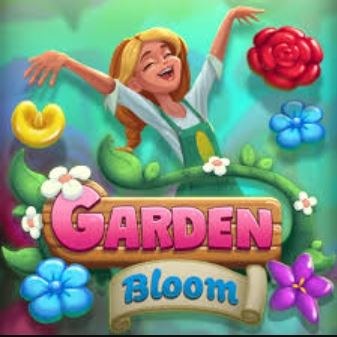
Garden Bloom is a tile-matching puzzle game disguised as a cozy gardening sim, but it quickly turns into a frantic battle against thorns and stems. You merge flowers to clear space while a relentless timer spawns hazards, forcing constant spatial planning. It suits players who enjoy deceptively tough logic games like Threes or Triple Town, not those seeking a relaxing experience.
I opened Garden Bloom expecting a gentle tile-matching thing, and for about forty seconds I was right. You get a grid, some bright flower tiles, and a calm little soundtrack that feels like a Sunday morning gardening show. Then the board starts filling faster than you can blink and the "relaxing" vibe evaporates. My first run ended in under two minutes because I was busy admiring the art instead of clearing stems. Don't do that.
What the first minute actually feels like
The tutorial stage drops you onto a 6x6 plot of soil with a handful of blooms already placed. Tap two adjacent matching flowers and they merge into a bigger, rarer bloom. The merged tile leaves behind a stem — a blocker you can't move or merge until you clear the row or column around it. The first thirty seconds feel generous. You're making daisies, then sunflowers, then a fat peony, and the combo sound effect gives you a little dopamine ping.
Then the timer bar at the top — which I completely ignored — hits the halfway mark and the game starts spawning thorn tiles. Thorns can't be merged. They just sit there, taking up space, and if three thorns touch, the whole cluster locks into a briar patch that takes two merges adjacent to it to clear. By the one-minute mark on my second attempt, half my board was thorns and I had a single tulip trapped in the corner like a hostage. That's Garden Bloom in a nutshell: a cozy-looking puzzle game that's actually a spatial logistics panic attack.
The loop isn't really about matching flowers
You'd think the goal is to create the highest-tier bloom possible — like a lotus or a royal orchid — and yes, that's what the score multiplier rewards. But the real loop is space management. Every merge creates a stem where the lower-tier flower used to be. Stems block further merges. You clear stems by completing a full row or column adjacent to them, which means you're constantly planning three moves ahead just to keep half the board usable.
What you're optimizing for, minute to minute, is breathing room. A board with six empty cells is comfortable. A board with two empty cells is a crisis. The game throws a new random flower or thorn into a random empty cell every few seconds, and that timer speeds up as your score climbs. So you're not just matching — you're strategically leaving certain cells open to bait the RNG, while trying to chain merges that clear multiple stems in one go.
There's also a compost bin mechanic: every tenth stem you clear fills a meter, and when it's full you can tap to remove any single tile from the board. I kept forgetting this existed for the first five runs. Don't. It's your emergency valve, and saving it for when a thorn cluster is about to lock is the difference between a 4-minute run and a 12-minute run.
Mistakes that end runs early
I made a list of the dumb things I did repeatedly so you can skip them:
- Merging toward the center first. It feels natural to build your big flowers in the middle where they have room to grow. But center merges create center stems, which split your board into two narrow corridors. Work the corners and edges early. Let the middle stay flexible as long as possible.
- Ignoring thorn adjacency. Two thorns separated by one empty cell is not safe. The game loves dropping a third thorn right between them. If you see two thorns within two squares of each other, clear one or fill that gap with a flower immediately.
- Wasting the compost on a flower you could merge away. I used my first three compost charges on tulips I was impatient about. Stupid. Compost is for thorns and locked stems only. A flower you don't want can always be merged upward or sideways eventually.
- Not checking what the next spawn preview shows. There's a tiny bud icon in the corner that tells you whether the next free-cell drop will be a flower or a hazard. I missed this for my first ten games. If it's a thorn, and you have a gap between two existing thorns, fill that gap now.
- Over-merging too fast. You can merge three, four, or even five identical flowers at once for a bonus. But merging a huge cluster often leaves a brutal stem pattern that boxes you in. Sometimes a two-flower merge that leaves a cleaner board is better than a five-flower merge that creates a cross of stems.
Phone versus desktop: not a small difference
I played about half my sessions on a Pixel phone and half on a desktop browser with a mouse, and the experience split in ways I didn't expect.
On desktop, precision is effortless. You click exactly the tile you want every time. This matters more than you'd think because the hitboxes on partially-bloomed flowers are slightly smaller than the tile, and on mobile I kept accidentally tapping the wrong adjacent flower, triggering a merge I didn't want. Undo does not exist. You live with your mistakes.
On phone, the portrait layout stacks the board higher on the screen, which means your thumbs naturally cover the bottom rows. The spawn preview icon is also smaller and easier to miss. But — and this is a real but — the phone version has haptic feedback on merges that I genuinely enjoyed. A little tap when daisies combine, a stronger buzz for rare blooms. It makes the game feel more tactile, almost like popping bubble wrap.
Battery drain is negligible on both. I played a 25-minute session on my phone and lost maybe 4% charge. The game also handles tab-switching gracefully; I left a run paused for ten minutes on desktop and came back right where I was, no refresh, no lost progress.
My honest recommendation: if you're chasing high scores, play on desktop with a mouse. The precision advantage is real and thorns are unforgiving. If you're playing to unwind for ten minutes, phone is perfectly fine and the haptics add charm. Just be ready for a few fat-finger disasters.
Who should actually play this
Garden Bloom is for people who like puzzle games that look soft but play mean. If you've enjoyed Threes, or the early-game pressure of something like Triple Town, the spatial crunch here will feel familiar and satisfying. There's a real skill curve: my first five runs averaged 800 points, and by run fifteen I was hitting 3,200 consistently, not because I got lucky but because I stopped making the same layout mistakes.
This is not a game for pure relaxation. The timer isn't optional, the thorns aren't cosmetic, and the late-game board state can get genuinely stressful. If you want a chill flower-matching experience with no time pressure, this isn't it — go find a merge game that lets you play at your own pace. Garden Bloom wants you to sweat a little.
Also worth noting: there are no ads between runs, just a subtle banner at the bottom of the menu screen. No energy system, no "wait 20 minutes for more compost" nonsense. You can restart instantly after a loss, which matters because you'll restart a lot. The free browser play model here is refreshingly unobtrusive.
A practical 10-minute practice plan
If you want to stop dying at the 800-point mark, here's what I'd do for ten focused minutes:
Minutes 0–3: Start a run and do not merge anything above a sunflower for the first 90 seconds. Just make pairs of daisies and tulips along the outer edge. Watch where stems land. Notice how an edge stem only blocks one direction, while a center stem blocks four. Internalize that.
Minutes 3–6: Restart. This time, focus only on preventing thorn clusters. Every time a thorn appears, say out loud "where's the second one" and scan the board. If there's another thorn within two squares, clear one or bridge them with a flower. Score doesn't matter. Survive to the two-minute mark without a briar patch forming.
Minutes 6–9: Restart again. Now play normally but force yourself to use the compost bin the moment it fills. Don't save it. Don't be precious. Just delete the most annoying tile on the board immediately. This builds the habit of actually using your tools instead of hoarding them.
Minutes 9–10: One more restart. Try to hit 1,000 points. By now you should notice the game feels slower because you're not constantly fighting thorn locks. Your merges will be cleaner, your board less cluttered. That's the baseline. From there, high scores come from chaining stem clears, not from making bigger flowers.
Garden Bloom clicked for me around the twelfth run, when I stopped treating it like a matching game and started treating it like a traffic-management puzzle with flowers. The art is lovely, the sound design is understated and pleasant, and the difficulty is way higher than the pastel color palette suggests. If you enjoy games that punish sloppy spatial thinking with a quick, brutal game-over, this one's worth your lunch break.