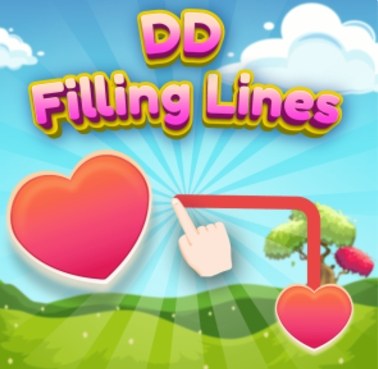
Filling Lines is a spatial puzzle game where you connect colored endpoints to fill a grid without crossing lines. It suits players who enjoy quiet, logic-driven challenges like Flow Free or The Witness, rewarding careful route planning over speed. Skip it if you need story, progression systems, or accessibility support for small touch targets.
First Minute on the Grid
I opened Filling Lines expecting something meditative. What I got was a quietly tense puzzle that had me frowning at my own choices within 45 seconds. The board starts as a mostly empty grid with a few colored lines already locked in place. You draw connections between same-colored endpoints, trying to fill every cell without crossing streams. The first level feels like a tutorial you don't need—just connect blue to blue, done. But by the third puzzle, I was already backing out of dead-end paths and realizing the game punishes greed.
There's no timer, no score counter ticking up. The pressure comes purely from watching your clean grid turn into a tangled mess because you rushed the obvious connections. I lost my first run not by failing to fill the board, but by trapping a yellow line behind a red one I'd drawn three moves earlier. The game doesn't warn you. It just sits there, letting you stare at the impossible gap you created.
What You're Actually Optimizing For
The loop is deceptively simple. Each puzzle gives you a grid of square cells, some already occupied by colored endpoints. Your job is to draw unbroken lines between every matching pair, covering every cell exactly once. A line can't cross another line or overlap itself. When you fill the last empty cell, the puzzle completes. That's it. No power-ups, no undo tokens, no move counters.
So what are you optimizing? Space efficiency. Every line you draw eats up cells that other lines might need later. The game trains you to think in terms of "who needs this corridor more." Blue might have a clear shot straight across the board, but if you take that direct route, you might wall off pink's only path to its partner three rows down. The best players I've watched (and I'm not one of them yet) treat early-game connections as negotiations, not victories.
A secondary optimization is visual scanning speed. As grids grow larger, you start needing to spot pairs that share constrained real estate. Two colors whose endpoints sit near each other in a crowded corner? Those need attention before the wide-open greens and oranges that could snake around later. The game rewards you for reading the board's bottlenecks before touching anything.
The Combos Don't Work How You Expect
Here's where the editorial angle gets interesting. "Building better chains" isn't about literal combos in the Candy Crush sense. There's no cascading, no bonus points for simultaneous clears. The chain-building is spatial. When you route a line cleverly, you create a channel that a second line can run parallel to without wasting cells. Then a third line tucks in beside those two. That's your chain—a tight bundle of routes sharing the same real estate efficiently.
I started noticing this around level 12. A puzzle had three warm-colored pairs—orange, yellow, pink—all clustered on the left half of the board. My instinct was to solve orange first since it had the shortest distance. But when I did, orange ate up prime central cells in a straight shot. Yellow had to loop awkwardly around the perimeter, and pink got boxed out entirely. Restart. This time I ran orange along the bottom edge, leaving the center open. Yellow slipped through the middle with a two-cell-wide corridor. Pink fit snugly above yellow. Three lines, minimal wasted space, all because I sequenced them to share the bottleneck.
The chains emerge from ordering, not from multipliers. You're building logical sequences where each line's path sets up the next one's viability. The satisfaction isn't a point explosion. It's the moment you realize you've routed four lines through a space that looked like it could only hold two.
Mistakes That Torpedo Your Run
I burned a good 20 minutes on one puzzle because of an error I'm calling the "greedy straight line." Two endpoints sat six cells apart with nothing between them. I drew the obvious straight connection, felt smug, then spent the next five minutes trying to cram three other colors around it. The straight line was optimal for that pair but disastrous for the board. Sometimes the best route between two points is intentionally inefficient—a slight detour that hugs a wall or loops around a future corridor.
Another run-killer: ignoring isolated pairs. Every few puzzles, you'll spot a color whose endpoints are practically touching, separated by maybe two cells. It's tempting to solve them immediately and get them off your mental checklist. Don't. Those tight pairs often sit in awkward corners where their tiny connection blocks a critical one-cell-wide passage that some distant color desperately needs later. Solve them last, or at least wait until you've mapped the long-distance routes.
The third mistake I kept making was forgetting that lines can turn. Obvious, right? But under mild frustration, my brain defaulted to straight shots and gentle curves. I'd stare at a seemingly impossible board, then realize the green line could make a hard 90-degree turn, snake up through an unused column, and arrive perfectly at its endpoint. Two extra cells of travel opened up the whole puzzle. Now I deliberately scan for L-shaped and S-shaped possibilities before declaring a board dead.
Oh, and if you're playing on a phone, fat-fingering a diagonal when you meant to go straight is a quiet tragedy. The game doesn't have a tap-to-cancel. Once a cell is claimed by a line, it's locked until you reset the whole puzzle. I've reset more puzzles from slip-of-thumb than from actual strategic failure.
Phone vs Desktop: It Matters Here
I tested this on both a laptop trackpad and a phone screen. Desktop with a mouse is the clear winner for precision, especially on larger grids where cells get small. The drag-to-draw mechanic feels natural with a cursor. On mobile, the touch targets are generous enough for early levels, but by the time you're working with 10-by-10 grids, individual cells shrink to the size of a fingertip. I found myself zooming in constantly, which breaks the flow of scanning the full board.
That said, the mobile version has one accidental advantage: you can't see the whole board at once on a smaller screen, which forces you to scroll and spot-check one region at a time. This weirdly aligns with the strategic scanning the game wants from you anyway. On desktop, I'd sometimes get overwhelmed staring at the entire grid and miss a small detail in the corner. Phone play narrows your focus, for better and worse.
If you have the choice, play the first dozen levels on whatever device is handy. Switch to desktop around the time grids cross the 8-by-8 threshold. Your accuracy will thank you.
Who Should Bother, Who Should Skip
Filling Lines is for people who like puzzles where the difficulty comes from spatial reasoning rather than time pressure or dexterity. If you enjoyed the pipe-connecting minigames in old BioShock or the circuit puzzles in The Witness, the DNA here will feel familiar. It scratches the same itch as Flow Free but with a stricter ruleset and no star ratings to chase. The satisfaction is quieter, more about the elegance of your solution than any external validation.
You'll also like this if you're the type who restarts puzzle levels voluntarily just to find a cleaner route. I caught myself doing that around level 18. The puzzle was solvable with my messy first attempt, but I knew there was a tighter chain arrangement possible. I reset three times chasing it. That's the target audience: people who optimize for beauty, not just completion.
Skip this if you need narrative hooks or progression systems to stay engaged. There's no story, no characters, no unlockable skins or currencies. The levels get harder, the grids get bigger, and that's your entire arc. If you bounce off pure puzzle games because they feel "pointless," Filling Lines won't change your mind. Also skip if you have vision or fine-motor accessibility needs—the color palette is muted and the touch targets get punishingly small at higher difficulties with no apparent accessibility settings.
A 10-Minute Practice Plan That Actually Builds Skill
I spent a few sessions deliberately drilling specific habits instead of just grinding levels. Here's a focused routine that tightened up my play noticeably:
Minutes 0–2: Constraint scanning. Open a puzzle but don't draw anything. Identify every pair that has at least one endpoint against a board edge or corner. These have limited escape directions, so they'll dictate routing for other lines. Count them. If more than half the pairs are edge-locked, the puzzle is fundamentally about border management. If most are free-floating, it's about interior corridor sharing.
Minutes 2–5: Longest-route-first attempt. Find the pair with the most distance between its endpoints, ignoring obstacles. Solve that pair first with the shortest reasonable path—not necessarily a straight line, but don't go crazy with detours either. Does the board still feel solvable? If not, reset and try routing that long pair along the perimeter instead of through the middle. Notice how the remaining space changes.
Minutes 5–8: Bottleneck challenge. Look for any row or column that's only two or three cells wide and must be crossed by multiple colors. These are your pinch points. Try to route your three most constrained colors through that bottleneck without them touching. If you can pack them in tight, the rest of the puzzle usually solves itself. If you can't, you found the puzzle's core tension.
Minutes 8–10: Deliberate restart drill. Take a puzzle you've already solved and reset it. Solve it again with a completely different ordering—if you started with blue last time, start with yellow now. Pay attention to whether the alternative sequence forces uglier paths or reveals a more efficient chain you missed. This builds the mental flexibility to abandon your first instinct, which is the skill that stops you from banging your head against a bad route for five minutes.
Ten minutes of this beats 30 minutes of mindless level-chaining. You'll start seeing board states in terms of shared corridors rather than individual connections, and that's when the game shifts from frustrating to satisfying.
Filling Lines is free in your browser, no download required, and it's exactly the kind of lunch-break puzzle that'll have you tilting your head at the screen while your soup goes cold. Just don't blame me when you start seeing colored lines on the ceiling at 2 AM.