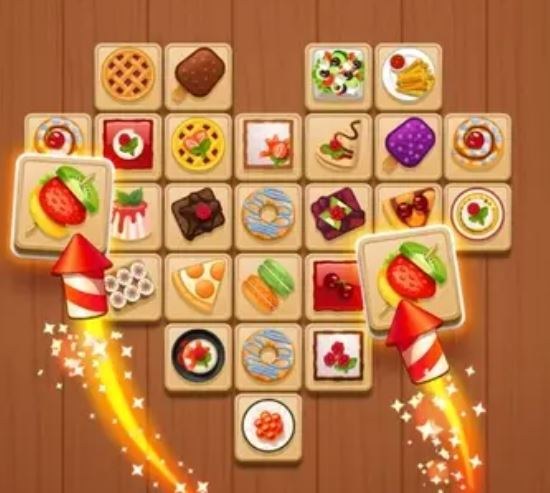
Onet Link is a calm puzzle game where you clear a grid by connecting matching tiles with a path that bends at most twice. It rewards careful planning over speed, making it ideal for players who enjoy untangling knots, like jigsaw or Sudoku fans. Skip it if you need action or urgency, as there’s no timer or dramatic fail state.
What You See in the First Minute
You load up Onet Link and it’s immediately calm. A grid of tiles sits in front of you, usually with simple icons — fruits, little animals, geometric shapes. There’s no timer ticking in your face, no frantic music. I clicked a tile, then another, and nothing happened. That’s when I realized the rule about linking. You need a clear path between two matching tiles, and that path can only bend twice. My first three attempts were just me tapping tiles that looked close together, wondering why the game wouldn’t clear them. The fourth try connected and the tiles vanished with a soft pop. I felt oddly satisfied.
The board shrinks as you clear pairs, but you’ll quickly notice that the remaining tiles clump together in awkward ways. What seemed easy at twenty tiles becomes a real puzzle when you’re down to eight, all stuck in different corners. That’s the loop — Onet Link isn’t about speed, it’s about not trapping yourself.
How the Core Loop Actually Works
Every level gives you a grid of tiles, always an even number. Your only job is to clear all of them by connecting identical pairs. The twist is the path restriction: the line you draw between them can have at most two 90-degree turns. You can’t cut through other tiles, and you can’t leave the grid boundaries. Some versions let you use the outer edge of the board as part of the path, and that matters more than you’d think.
What you’re really optimizing for is order of removal. The game isn’t testing your reflexes. It’s testing whether you can see which pairs are blocking other pairs. A tile in the middle of a dense cluster might have three matches available, but only one of those matches opens up the board. Pick wrong and you’ll leave a stranded tile with no possible partner. I lost a run three minutes in because I cleared the easy outer pairs first, leaving two identical tiles buried behind a wall of mismatched icons. The game doesn’t warn you — it just sits there, waiting, until you hit the shuffle button or restart.
Shuffles are limited. Usually you get one or two per level, sometimes you earn more by watching a short ad. That’s the only monetization I noticed, and it’s unobtrusive. You can absolutely play the free browser version without ever touching it if you plan your moves.
What Beginners Get Wrong (I Did Too)
The biggest mistake is clearing tiles just because you can. Early on, you’ll see a match sitting right next to each other and your brain screams “grab it.” Don’t. At least not always. Those adjacent pairs are often the least urgent. They’re already accessible. The tiles you should prioritize are the ones that are currently blocking multiple other matches. If a tile has two or three identical siblings but they’re all trapped behind it, removing that blocker frees up three future moves at once. That’s the kind of thinking that saves you from burning a shuffle later.
Another common trap: ignoring edge tiles. The perimeter of the board is valuable real estate. Tiles on the edge have fewer neighbors, so paths can route around them more easily. If you clear all your edge tiles first, you’re left with a dense core of tiles that are hard to link without violating the two-turn rule. I started treating edge pairs as a resource to spend after I’d thinned the center. It felt counterintuitive but it worked.
Also, people don’t scan the full board. I caught myself staring at one quadrant, clearing everything there, then looking up to find I’d orphaned a tile on the opposite side. Train yourself to do a quick full-grid sweep before every move. Look for tiles that appear only twice. Those are your bottlenecks. If you lose track of one of them, the level is probably over.
Phone vs Desktop: It Changes How You Play
I tried Onet Link on both a laptop and a phone. On desktop, the larger screen makes it easier to scan the whole grid at once. You can see paths more clearly, and the mouse gives you precision on crowded boards. On a phone, the tiles are smaller, and my thumb occasionally tapped the wrong icon when tiles were tightly packed. Not a dealbreaker, but it did make me play more slowly, which honestly might be better for a beginner. The slower pace forced me to double-check paths before committing.
One thing that’s nicer on mobile: the tactile feel of drawing the connection with your finger. The line snaps into place and it’s more satisfying than clicking. If you’re prone to rushing, I’d say start on desktop. If you want to train patience, mobile works fine. The free browser version on desktop had no ads interrupting gameplay, which I appreciated. On mobile, the occasional shuffle-for-ad prompt popped up, but it never felt aggressive.
Who Should Bother With This Game
Onet Link is for people who like untangling knots. If you enjoy jigsaw puzzles, sorting tasks, or the gentle logic of a Sudoku, you’ll probably click with it. There’s no story, no characters, no progression system beyond clearing harder boards. The satisfaction is purely in the solve. It’s the kind of game you play while listening to a podcast, or during a ten-minute break when you want your brain to shift gears without stress.
Who should skip it? If you need action, stakes, or a sense of urgency, this won’t hold you. There’s no fail state with a game-over screen — you just get stuck and have to restart or shuffle. Some people find that frustrating in a different way, like a puzzle that refuses to fight back but also refuses to solve itself. If you want clear feedback and dramatic moments, look elsewhere. Also, if you have vision issues, the tile icons can be small, especially on mobile. No accessibility options that I could find, which is worth noting.
A Practical 10-Minute Practice Plan
If you’re brand new and want to get decent fast, here’s a focused way to spend your first ten minutes. I did this with a friend who kept getting stuck on the third board, and it helped.
First two minutes: don’t try to win. Just open a level and practice identifying all the pairs on the board. Actually point to each pair with your finger or cursor. Count them. You’ll start to notice which tiles have only one possible match — those are your critical tiles.
Next three minutes: play a level but only clear pairs that are not touching each other. Force yourself to look for matches that require a bent path. This trains your eye to see indirect connections, which is the whole skill of the game. You’ll lose some levels, that’s fine.
Minutes six through eight: focus exclusively on clearing tiles from the center of the board outward. Ignore edges completely. Notice how the board opens up. After two or three attempts, you’ll get a feel for why center-first matters.
Final two minutes: play normally, but speak your moves out loud. Say “I’m clearing this pair because it frees up these two tiles.” The verbal check stops you from acting on impulse. I sounded ridiculous mumbling to my screen, but my win rate jumped immediately.
That’s the whole ramp. Onet Link doesn’t have hidden depth — it’s exactly what it looks like. But the tiny decisions you make in the first thirty seconds of a level echo all the way to the last two tiles. Get those right and you’ll rarely need a shuffle.