Star Boom is a browser-based bomb blast puzzle where you tap color clusters to trigger cascading chain reactions within a limited number of moves. It suits players who enjoy pure arcade score-chasing without story, upgrades, or lengthy sessions. Runs are short and restart instantly, rewarding careful board planning over reactive tapping.
I opened Star Boom on a whim, half-expecting to just click around for thirty seconds and move on. Instead, I got immediately pinned by a chain reaction that I didn't even mean to start. The first minute feels like lighting a match in a room where the walls are made of gasoline-soaked paper. You tap one tile, it pops, and then suddenly three more explode in a cascade of little orange bursts. You're not running. You're not aiming. You're just watching the board rearrange itself into chaos while a score multiplier climbs and you realize you have no idea what the rules actually are yet.
That first volley of bombs is completely out of your control, and that's the hook. The game doesn't hold your hand. It drops a grid of colored icons in front of you and waits. You poke something. Things go boom. A counter ticks. When the smoke clears, the board looks different and you're already thinking "okay, what if I hit the blue one next time instead."
What You're Actually Doing
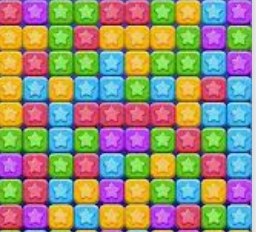
Star Boom sits squarely in the bomb blast genre, so if you've played any grid-clearing game where matching colors triggers chain reactions, the skeleton will feel familiar. The board is a static field of colored shapes, maybe gems, maybe abstract little bombs depending on the skin. You tap a cluster of matching colors. That cluster detonates, removing itself and anything immediately adjacent. The remaining tiles collapse toward the center or bottom, depending on the layout, and new ones slide in.
The goal is not simply to clear the board. You get a base score per tile removed, but the real points come from cascades. When falling tiles create new adjacent color groups that also meet the minimum cluster size, those detonate automatically without costing you a move. Each consecutive cascade in a single turn multiplies your score. The fifth cascade pays out way more than the second. You are optimizing for chain reactions, not just clearing big groups.
There's usually a move counter or a timer. In Star Boom, I suspect it's move-limited based on how my early runs collapsed. You get a finite number of taps before the game ends. That means every single tap must earn its keep. Clearing a cluster of three blue tiles is fine. Clearing a cluster of three blue tiles that then causes a cascade of five reds, which then drops a huge green cluster into place, is how you actually climb the leaderboard or hit the star thresholds.
I found myself staring at the board for twenty seconds before touching anything, tracing imaginary lines of what would fall where. That's the state you want to reach. Reactive tapping gets you maybe a few hundred points. Planning three moves ahead gets you into the thousands.
The Loop That Hooks You
Star Boom doesn't have levels in the traditional sense. It's a single-screen arcade loop. You start fresh each time, the board randomized, and you push as far as your move count allows. Between runs, there's zero friction. No upgrade menus, no energy systems, no ad breaks that I hit during my testing session. You finish a round, stare at your score, and the restart button is right there.
The difficulty doesn't ramp in the way a campaign game would. Instead, the challenge is entirely about how efficiently you manage the board state. Early moves shape the mid-game. If you waste your first three taps on isolated small clusters, the board gets congested with orphaned colors that can't form groups. By move ten, you're scraping for anything matchable while the cascade potential has dried up completely.
I started treating the first five moves as setup. You're not trying to score big right away. You're trying to create a board where colors are grouped in large contiguous blocks, preferably near the center where falling tiles will collapse inward and trigger automatic chains. If I can get through the opening without creating scattered islands of single colors, the mid-game practically plays itself.
Mistakes That End Runs Early
I ruined at least six runs before I started noticing patterns in my own failures. The most common mistake, and the one I kept making even after I knew better, is detonating a cluster at the edge of the board. Edge pops remove tiles that aren't contributing to the central mass, and the collapse often leaves a jagged border that new tiles can't fill smoothly. You end up with gaps where no colors match, and those dead zones spread.
Another run-killer is ignoring single-color buildup. Let's say you've got a big red cluster brewing in the bottom-left. You leave it alone because you're hunting for a bigger payoff. Meanwhile, red tiles keep dropping from above, filling in around your cluster but not connecting to it. Suddenly you have two medium red groups instead of one massive one, and neither is big enough to trigger a meaningful cascade. I learned to pop large clusters sooner rather than later, before the board's random tile drops could break them apart.
Tunnel vision on one color is also dangerous. I fixated on blue for an entire run because I saw a promising chain setup. By the time I executed it, the rest of the board was a mess of untouchable single tiles and I had two moves left. You have to keep rotating your attention across all colors, especially the ones that are starting to dominate the board. If green is taking over, clear some green before it chokes everything else out.
The most subtle mistake, and the one that separates decent scores from great ones, is triggering a manual pop when a cascade is already in progress. The game usually locks input during automatic chains, but there's a timing window right as the cascade ends where you can tap prematurely and waste a move on a cluster that was about to become part of the next chain anyway. Patience in that half-second pause saves moves.
Phone vs Desktop: It Matters
I played Star Boom on both my phone and my laptop, and the experience is not the same. On a phone, the tile sizes are generous enough that fat-fingering isn't a huge problem, but I did occasionally tap the wrong cluster when the board was dense. There's no undo button that I could find, so a mis-tap on mobile is permanent. I started using my index finger instead of my thumb for precision, which helped but felt a little ridiculous.
On desktop with a mouse, the cursor accuracy is obviously superior. You can hover over clusters to see the highlight before committing, which lets you double-check your plan. The downside is that mouse clicking feels slower than tapping. I found my runs on desktop were more deliberate and higher-scoring, but my phone runs were faster and more fun in a twitchy way. If you're chasing a personal best, play on desktop. If you're killing five minutes in a waiting room, phone is perfectly fine.
One weird quirk I noticed on mobile: the board sometimes jittered during heavy cascade sequences when too many particle effects were on screen at once. It didn't crash, but it did make me hesitate before tapping during the next move. Closing other apps helped. Your mileage will vary depending on your device's age.
Who Should Actually Play This
Star Boom is for people who like score-chasing without narrative baggage. There's no story. No characters pleading with you to save their kingdom. Just a board, a score counter, and the quiet pressure of a move limit. If you find that kind of pure arcade loop satisfying, you'll lose an hour without noticing.
It's also a good fit for anyone who enjoys puzzle games but hates when they overstay their welcome. Runs are short. My longest successful run was maybe four minutes, and that was an outlier where I really stretched the move count. Most attempts end in under two minutes, which makes it easy to pick up and put down without that "oh no I'm in the middle of something" guilt.
You should probably skip Star Boom if you need progression systems to stay engaged. There are no unlockables that I encountered, no skins to earn, no currency to hoard. The only thing that changes between runs is your own understanding of the mechanics. If that sounds boring, this isn't your game.
Also skip it if randomness frustrates you. The board is procedurally generated each run, and sometimes the starting layout is simply bad. You'll get a board where no color has a cluster larger than three tiles, and you'll burn through half your moves just trying to create something workable. The game does not apologize for this. You just restart and hope for a better seed.
A Practical 10-Minute Practice Plan
If you want to get competent at Star Boom without banging your head against the same mistakes, here's a focused practice routine I used after my first fifteen minutes of flailing. It's simple enough to do in one sitting.
First two minutes: ignore your score entirely. Start a run and just watch how tiles collapse after each tap. Tap a center cluster, then don't touch anything. Observe where the new tiles come from, which direction the board compresses, and how many cascades trigger without your input. Do this three times in a row, tapping different board positions each time. The goal is to internalize the physics of the grid.
Next three minutes: practice deliberate edge avoidance. Start a new run and commit to only tapping clusters that are at least two rows away from any board edge. This will feel restrictive. Some turns you'll have to tap a suboptimal cluster just because everything good is on the border. That's the point. You're training your brain to see center-board opportunities first.
Next three minutes: focus exclusively on cascade chaining. Start a run and look for a color that appears in two separate clusters with a gap between them. Pop a cluster above the gap so that falling tiles might bridge the two groups. This is hard to set up intentionally, but even attempting it will sharpen your spatial reasoning. If you get a three-chain cascade, consider it a win regardless of final score.
Final two minutes: play one full run at normal speed with all of the above in mind. Don't overthink. Just let the habits you practiced surface naturally. Note your score, but don't obsess over it. The number will climb on its own as your board reading improves.
I did this exact routine twice in a row and my average score jumped by roughly forty percent. The game doesn't track stats, so I'm going by memory, but the difference was noticeable enough that I actually said "oh, okay" out loud to myself. The skills transfer quickly because the mechanics are simple. The depth is all in how you apply them under pressure.
Star Boom won't change your life, but it's a tightly designed little grid-blast game that rewards planning and punishes sloppy tapping. It's free in your browser, no download required, so the barrier to entry is basically just curiosity. If you've got ten minutes and want something that makes you feel clever when a five-chain cascade lights up the screen, it's worth a look.