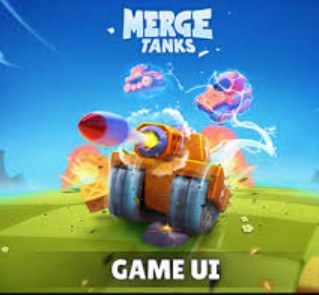
Merge Tanks is a spatial puzzle game where you combine identical tanks to free up board space, with the real threat being a grid that fills faster than you can clear it. It suits players who enjoy 2048-style optimization and managing self-created chaos, but not those who need story, idle progress, or an undo button.
First 60 Seconds: The Table Is Already Messy
You open Merge Tanks and there's no tutorial hand-holding. Just a grid with two identical starter tanks sitting next to each other, a few empty slots, and a coin counter reading zero. The instinct is immediate: drag one onto the other. They combine into something slightly meaner-looking — a tier-two tank with a bigger barrel and a dull grey paint job. The game doesn't applaud. It just spawns a new tier-one tank in a random empty square, and now you've got four things on the board, one of them already blocking the spot you were saving. That's the whole mood. You're not a commander. You're a warehouse manager who accidentally started a proxy war.
The first minute feels like clearing a table that refuses to stay cleared. You merge two tanks, the space fills. You merge again, a coin drops. You buy a new tank from the shop because you're one short of a combo, and the new tank lands exactly where you didn't want it. The merge chain you'd lined up in your head falls apart. You realize the game isn't about making the biggest tank — it's about not letting the small ones overrun you before you can afford the merge that saves the run.
What You're Actually Optimizing For
Merge Tanks belongs to that school of merge games where the board is your enemy as much as any external threat. There aren't waves of attackers here (at least not in the casual mode I spent most of my time with). The pressure is spatial. Every new spawn eats a tile. If you fill the board, the run ends. Your real resource isn't coins or tank levels — it's empty squares.
The loop works like this: you combine two identical tanks to create one tank of the next tier. Higher-tier tanks periodically generate coins, and coins let you buy new base-level tanks from the shop. Buying tanks is how you get the duplicates you need to keep merging upward. So the engine is a triangle — merge to free space, earn coins from high-tier tanks, spend coins to buy more tanks, which threaten to fill the board again. The skill is in deciding when to buy, when to wait for a natural spawn, and when to merge early even if it breaks a potential bigger combo later.
What surprised me after a few runs is that the highest-tier tank isn't the win condition. I had a run where I rushed a tier-five tank by minute four and felt smug about it, then died two minutes later because I'd used up so many board slots chasing that merge that I couldn't recover when three bad spawns clogged the corners. The game rewards the player who keeps four or five merge chains alive at different tiers, not the one who tunnel-visions a single super-unit. You're optimizing for board flexibility, not peak firepower.
Mistakes That Kill Runs Before You Notice
I lost more runs to impatience than to bad luck. Here's what actually ended things early, run after run:
- Buying a tank when you have exactly one empty slot. It feels safe because you'll merge it immediately, right? Except the new tank might not match anything on the board, and now that one empty slot is gone. If the next natural spawn also doesn't match, you're locked. I started treating the shop button as a commitment I had to justify, not a reflex.
- Merging three tanks at once when two would do. The game lets you drag a tank over two identical neighbors if they're adjacent. It's satisfying. But it often leaves you with a high-tier tank surrounded by empty space you can't use efficiently because the remaining low-tier tanks are stranded on the other side of the board. I learned to merge in pairs deliberately, even when a triple was available, unless I had a clear plan for the leftover space.
- Ignoring corner tanks. Tanks in corners can't merge with anything unless you drag something next to them, and dragging costs a move you could have spent elsewhere. I developed a mild paranoia about letting base-tier tanks settle into the four corner squares. If one lands there, I either merge it out immediately or accept that it's dead weight for the next two minutes.
- Overvaluing coin generation. Higher-tier tanks produce coins faster, yes. But a tier-four tank sitting alone on the board generating coins while you drown in tier-ones is a trap. You'll have wealth and nowhere to spend it because the board is full. Coin generation matters only if you have the board space to convert coins into merges. I started prioritizing merges that freed two squares over merges that gave me a slightly better coin rate.
Phone vs Desktop: The Drag Difference
I played Merge Tanks on both a laptop trackpad and a phone screen. On desktop, dragging tanks feels precise but slow — you're making deliberate, almost chess-like moves. On a phone, the drag is faster and more casual, but I mis-dropped tanks constantly in my first session. The hitbox for placing a tank into a specific square is slightly smaller than my thumb expected, and I merged the wrong pair twice in one run because I dragged a tank over a neighbor on the way to its intended target. The game registered the first valid merge and ate my move.
If you're playing on a phone, I'd recommend using a fingertip rather than a thumb for drags, at least until you internalize the grid spacing. Desktop gives you more control but also invites overthinking. I found my phone runs were faster and more reckless in a way that actually suited the game's tempo. Desktop runs lasted longer but felt more punishing when I made a mistake, because I'd spent more time planning the board state I just ruined.
The game runs fine in a browser on either device. No install, no account, just a URL. It loaded quickly on mediocre coffee-shop Wi-Fi, which is the bar that matters for a casual merge game you're playing while waiting for something else.
Who Should Play This, and Who Should Skip
Merge Tanks is for people who enjoy spatial puzzles where the difficulty comes from your own past decisions piling up. If you've played 2048 and thought "I wish this had tanks and slightly more going on," you're the target audience. It scratches the same itch as those "organize the warehouse" sections of job-simulator games, but without the narrative wrapper. The satisfaction is purely mechanical: you look at a board that was chaos thirty seconds ago, and now it's orderly, and you did that.
It's also a good fit if you want a merge game that doesn't demand a wiki. There are no event timers, no limited-edition units, no battle passes. The progression is just tank tiers, and you can see the whole upgrade path within a few runs. That simplicity is the point.
Skip this if you need a story or characters to care about. There's no campaign, no dialogue, no sense of why you're merging tanks beyond the fact that merging tanks is what the game does. Also skip it if you hate games where one careless drag can undo ten minutes of careful planning. The game doesn't have an undo button, and I felt that absence acutely in my third or fourth run when I merged the wrong pair and instantly filled my last open column. If that kind of moment makes you close a tab, this isn't your game.
People who enjoy idle or clicker games might find Merge Tanks a little too hands-on. There's no offline progress, no automation. You're actively dragging and planning the whole time. It's casual in session length — a good run is maybe fifteen minutes — but not casual in attention required.
A Practical 10-Minute Practice Plan
After about twenty runs, I noticed my survival time clustered around two breakpoints: either I died before the five-minute mark because of an early board clog, or I cruised past ten minutes and felt in control until a slow squeeze around minute twelve. The difference was almost always what I did in the first sixty seconds. So I made a deliberate practice routine for the opening, and it helped.
Here's the ten-minute drill I settled on. It's not about winning — it's about training the habits that make winning possible later.
Minutes 0–2: Don't buy anything. Resist the shop entirely. Work only with the tanks the game spawns naturally. The goal here is to practice merging with what you're given, which forces you to scan the whole board instead of fixating on the shop button. By the two-minute mark, you should have at least one tier-three tank and no more than two empty squares. If you have more empty squares than that, you're merging too conservatively.
Minutes 2–4: Make one purchase, then wait. Buy exactly one tank from the shop, and only when you have at least two empty squares. Use that purchase to complete a merge you've been holding. Then stop buying. The goal is to learn the rhythm of "buy to complete, not buy to start." If the purchase doesn't immediately enable a merge, you bought at the wrong time.
Minutes 4–7: Maintain three merge chains. By now you should have tanks at three different tiers evolving in parallel. Count them. If you're only working on one chain, you're vulnerable to a bad spawn sequence. If you're working on more than four, you're spreading too thin and your board is probably a mess. Three is the sweet spot I found — enough redundancy that one stalled chain doesn't kill you, but not so many that you can't hold the board state in your head.
Minutes 7–10: Let a corner go. This sounds wrong, but it's deliberate. Around minute seven, identify the tank that's causing you the most problems — probably a tier-one in a corner that you've been ignoring. Instead of trying to rescue it, spend the next three minutes working around it. Merge everything else as if that square doesn't exist. The exercise teaches you that one dead square isn't a run-ender if you stop throwing good moves after bad. You'll be surprised how long you can survive with ten functional squares and one frozen corner.
Do that drill three times, even if you "lose" each run. By the third attempt, your fingers will know the drag distance without thinking, and you'll start seeing merge opportunities a move ahead. That's the point where the game shifts from stressful to almost meditative.
Merge Tanks won't change your life. It's a free browser game about dragging cartoon tanks into each other. But for the fifteen minutes you spend optimizing a grid while the world outside is loud, it does exactly what it's supposed to do.